

It’s the coldness of the stethoscope on Deidre’s bony chest that startles her awake. Her bedroom is dark, a collection of shadows, and the people she sees are nothing but colorful blurs: Dr. Ward, in his tan suit and blue bowtie, small but purposeful, as he takes the plugs of his stethoscope from his ears; Averil, angelic in white, as she efficiently examines the morphine hanging from the intravenous pole; and Nolan, in his blue overalls, standing by the window, cowering, as if he was folding in on himself.
“Well?” Averil says.
“Is it …?” Nolan says.
“It’s a matter of time,” Dr. Ward says.
Paltry light flickers through the part in the curtains, trying to stem the shadows from growing into an encompassing darkness. This is life now – or what’s left of it. And in the acknowledgement of so few heartbeats remaining, it’s Keene who Deidre seeks out. An imprint of his small body remains in bed beside her, the covers pulled back. Him spending the night by her side was one final treat – a boy terrified of a thunderstorm wanting his mother. The pain means nothing now as she thinks of how he will cope once she’s gone – if he will be able to. He is only seven. How does anybody that age understand and deal with death?
“Deidre,” Dr. Ward says, “how’re you feeling?”
Deidre’s breath rattles in her chest as she summons a smile. The fight is done. She’s had long enough to come to terms with that. Now all that remains is this final communion before whatever comes next. Dr. Ward nods, understanding, and pats her shoulder.
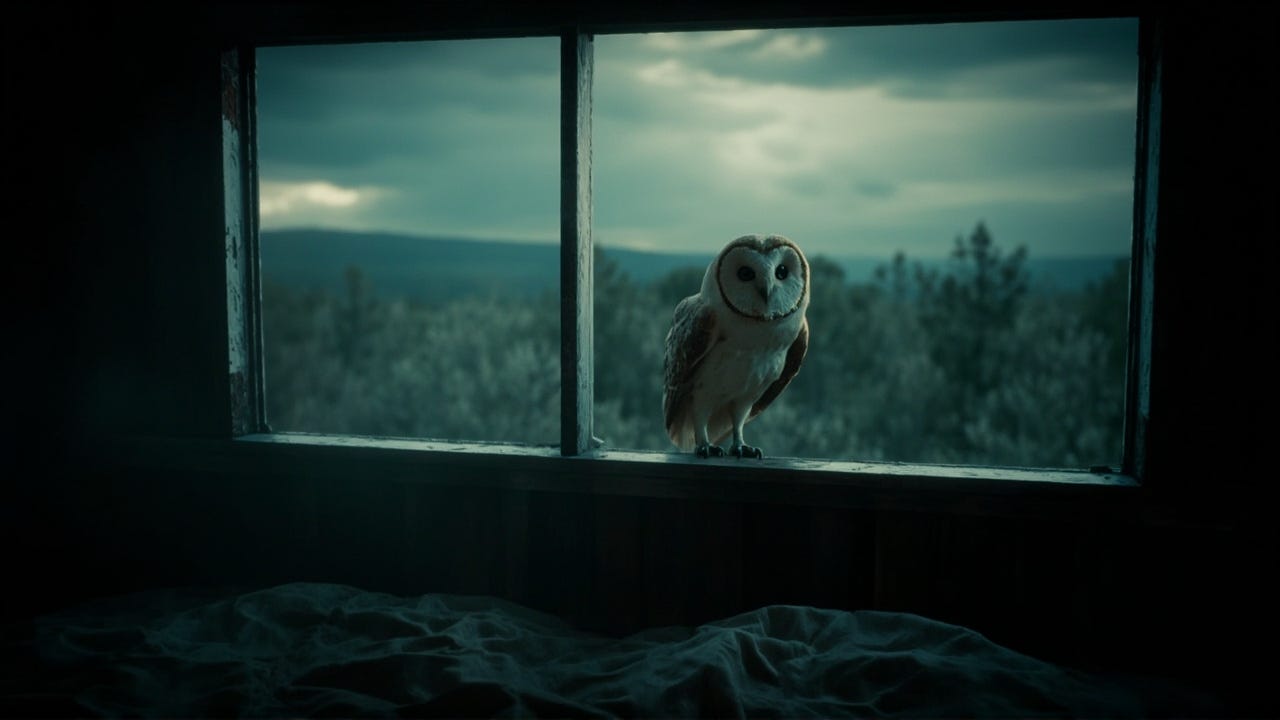
Averil draws the curtains to reveal rain has splattered the window and swirling thunderclouds fill the sky. A barn owl is perched on the sill outside but, startled by Averil’s appearance, leaps, flutters its wings and sails away, leaving nothing but a brief but glorious misty white contrail.
“I have a couple of patients to see before the storm hits,” Dr. Ward says. “But I’ll be back.”
“I’ll see you out,” Averil says.
She again checks the morphine bag on the intravenous pole, but more as if to busy and distract herself. Then she nods at Deidre, but shies away quickly, although not quick enough to hide that her eyes sparkle with unshed tears. She leads Dr. Ward from the room, quietly closing the door behind them.
Nolan sits on the bedside, Deidre struggling to focus on him. He hasn’t washed his clothes for a while – that much is evident; his overalls are dirt-stained and worn, the left strap – yet again – torn loose from the button. Deidre would like to sew it, just as she used to, and lifts her hands trying to find the muscle memory, but her hands are skeletal and weak. She lowers them to her midriff and feels the protrusion of her ribs. Nolan clasps her wrist, taking care not to disturb the cannula that sinks into her pale skin.
“Keene?” Deidre says, although there’s little strength in her voice.
“He was having breakfast,” Nolan says. “Tore up the house last night looking for that pendant he bought you. He thinks if he finds it you’ll get better.”
A citrine pendant he’d bought from the school fair. Whoever had sold it had impressed upon him the supposed virtues of crystals. But she’d lost it – hung it on the branch of a tree and forgotten it during a family outing to Miller’s Pond one hot summer’s day. The next day she’d found the lump and Nolan had sped her to the doctor, as if the lump was a time bomb that could be defused before it exploded.
Here was Keene’s logic: if he could find the pendant, she’d be okay – logic that is so simple and so charming in its naivety, but also so fallible that learning the truth could scar him. Children are so impressionable. And Keene is sensitive. Deidre worries how he and Nolan will cope together.
“Do you want me to call him?” Nolan asks.
Deidre can only manage to shake her head once. “Not yet.” It’s too early. The pain and exhaustion press at her until she’s being crushed, but she knows she’ll have one last respite, as brief as it will be. That will be the time to see Keene.
Nolan’s fingertips trace her cheek. “What can I do for you? Music?”
An old, small stereo sits in the corner, surrounded by an unruly pile of classical CDs. She would like to hear music now. The wind outside howls and rain hammers the roof. Thunder booms and the house creaks all over, as if it’s recoiling and is shivering in fear. Music would be good – the harmony in the chaos – but it’s something she shares with Keene. She could not listen to it without him. And Nolan has no appreciation of anything but rock.
Perhaps understanding, Nolan gently lowers himself by her side, one arm curling around her, his face nuzzling against her cheek. He is too warm. Deidre is not used to it. But she welcomes it as a shield against the chill in the room and the darkness that leaks from the corners. His presence will help stay death – for a little while at least. And she will have her husband lay by her side this one last time.
“This is not the way it’s meant to be,” Nolan says, his breath hot on her ear. “This is …”
Deidre is thankful his voice breaks. She takes a breath, shallow as it moves through her chest, thin and whistling as it sits in her diaphragm. No, it’s not as it’s meant to be. She has run that gamut already. How many lives unfold as they’re meant to be? Life forces detours on the way to meant to be and so many never reach the destinations they idealize.
“Don’t think like that,” she says. “Tell me what you’re going to do.”
“What can I do?”
“Tomorrow. And the next day. And the day after. You said lightning hit the tree outside …?”
“Last night. The branch splintered right through Keene’s room.”
“How’re you going to fix it?”
“I don’t—”
“Tell me, Nolan.”
Nolan gulps.
“Tell me … Please.”
“The council … They’re already here, taking it down – Bob McKenna owed me a favor, so I got them in straight away. I guess the insurance can cover the damage. Maybe that’ll help with the bank as well. I don’t know. I really don’t—”
Please, Nolan.
Does he sense her wordless plea? Deidre doesn’t know, but would like to think it’s the case. He kisses her cheek, his stubble scratchy. Thunder rumbles, then lightning flashes through the room and sears Deidre’s eyes. Shadows twirl up from the floor and she feels, fleetingly, that they’re wraiths rising to claim her. Her hand clenches over her chest; she looks through the window and to the dark and foreboding clouds that may be the blanket that will fall upon her life and darken it forever.
She yearns for one final glance at sunlight, and her mind goes back to that outing at Miller’s Pond, swimming with Nolan and Keene, and even with Bunch, the Border Collie enthusiastically chasing his ball across the lake. It was the last happy and carefree day they shared as a family. After that, it was doctors and hospitals and failing treatments, and her freedom dwindling until she’s been left with nothing but this room and the shadows.
For now, she revels in the normalcy that her husband can cuddle her, at least for this little bit. She sleeps and dreams that when she wakes, she’ll head downstairs, call for Keene and Bunch from the yard, then retreat to the kitchen, warm and glowing in the evening sun, scones baking in the oven. Nolan will sit at the kitchen table, that silly strap still hanging loose from his overalls, reading the paper over a beer. They’ll eat and laugh, Keene clumsily sneaking scraps to Bunch when he thinks they’re not looking, and then head into the lounge, where she will sit with Keene at the piano and teach him Mozart’s concertos. Keene has a gift that needs to be nurtured.
A thunderclap startles Deidre. Her eyes snap open. The room is still. Nolan remains by her side, but his breath is slow. The darkness closes in. Deidre’s mind is quiet and she barely feels the bed beneath her. Now there’s no pain – nothing but tiredness. But it’s not the usual exhaustion that comes from her body fighting to survive, but a tiredness where the peacefulness of everlasting sleep beckons. The window bounces under the rain’s assault and the wind shrieks.
“Nolan?”
The word struggles from her lips, no louder than his breathing, but he is up immediately.
“What is it?” he asks.
“It’s time.”
Nolan shakes his head. “No.”
Deidre doesn’t argue. Her hand closes above her chest. “Find Keene …?”
Nolan jumps up so quickly that the bed judders and he almost bounces out of the room. Deidre hears his feet thump down the stairs as he calls again and again for Keene. She expects that soon Keene’s voice will pipe in, bright and clear, “Here, Dad!” but there is no response. She tries to echo Nolan’s calls, but her throat is rough and she has no breath to power her voice above a warble.
Averil enters the room, and replaces the morphine bag – not that it matters anymore. “Nolan’s finding Keene,” she says, but more as if to assure herself.
Deidre nods, a small tip of her chin. “I’m going to have a little sleep. Wake me when he comes.”
“Deidre …?”
“It’s all right.”
Deidre closes her eyes, tells herself she needs a moment’s rest, but it would be so easy to slip away now, to blink one final time and know no more. But she can’t do that. She can’t go without saying goodbye to her little boy. Keene is her only tether now, and she will hold onto it as grimly and desperately as she can.
The screen door screeches open and clatters shut. The storm fades, the rain little more than a drizzle, the sort Deidre would’ve once listened to, would’ve shrouded herself in as she slept in on Sunday mornings. Then she would fold into Nolan, nestle her face on his chest, and bask in his warmth; and then, later, Keene, running in as fast as his little legs can carry him, would charge in, hurl himself onto the bed, and burrow under the covers between them.
“Keene …?”
Deidre doesn’t know if she is awake or asleep when she says his name, or if she has even said it at all. Then, muted violins, slow, but melodious fill the room and elevate it above the inevitability of what awaits her. Other instruments join in – more violins, cellos, and bass. She fleetingly thinks she has passed and this divine music greets her in the afterlife, but then she identifies it as Mozart, the second movement of his Piano Concerto 21. The sublime tranquility of the music is a fitting chaperone for what time she has left.
She opens her eyes. Cracks have appeared in the clouds and sunlight sprinkles over the house. She’s sure she feels the warmth frittering over her. The music fills the stillness of her body. Keene has put a CD on the stereo – part of the routine they share. He walks up to the bedside, his hair wet, like he has just showered, and in a fresh set of clothes. He holds his hands behind his back. She tries to smile but her lips don’t move.
“Mum,” Keene says as he climbs up onto the edge of the bed.
“What did you do today?” Deidre asks.
She struggles to get the words out, but this is part of their routine – what she asks every visit. He knows and beams with that adolescent need to impress, to make her proud. She tries to lift her hand to stroke Keene’s cheek, but cannot get it above her chest. Keene kisses her on the head.
“I went and got you a surprise,” Keene says.
“A surprise?” A smile tugs at her lips. During yesterday’s visit, he told her he’d drawn something for her – a picture to join the array of others they’ve stuck to the wall by the door to form a collage of startling color. “Your picture?” she asks.
“Better!”
Keene opens his hand. Her pendant – the very pendant she’d unwittingly left behind at Miller’s Pond – falls from it, jags upon the cord wrapped around his palm, then swings back and forth. Her disbelief swells.
“Kee, how did you …?”
“I went and got it. Me and Bunch.”
This is no boast, as it might be in somebody older – he does not understand the weather he has braved, or the dangers it represents. Even on a fine day he should not be venturing into the bush alone. But he is completely without ego, instead beaming with delight that he has won her surprise.
He lays the pendant on her chest. Her hand shapes around it with familiarity. Her chest heaves. Outside, the owl returns – wings fluttering as it perches outside the window. It watches her, eyes large and golden.
“That was very sweet of you, Kee.”
“Now you can get better.” Keene’s face shines with innocence.
“Better?”
“The pendant will make you better.”
Deidre frowns as trepidation fills her, and then overflows. The shadows rise around her and writhe in contempt. “No, Kee …”
“But you only got sick because you lost it.”
“No …”
“Get better now, Mum.” Keene shakes her by the shoulder.
She wishes she could hold him, could soothe him, and come the morning that he could wake and his fears would be forgotten.
“Kee, I’m not going to get better.”
“What do you mean?”
“I have to go …”
Keene frowns and his hand tightens around the pendant. He lies by her side, rests his head against her temple and draws his arm across her. She opens and closes her hand on the pendant as it sits on her chest.
“Mum …”
“Kee …” Deidre summons what strength remains and turns her head, just an inch, but enough that her eyelashes flicker upon his, her dark eyes wet. Her hand closes over the pendant. It has no power but its retrieval offers another kind of magic – a magic that fills her with a certainty that Keene is a boy both resilient and capable and resourceful. She doesn’t want to leave him, but is sure now – sure in a way that she doesn’t understand – that, ultimately, despite all the hardships he’ll face, that he will be okay. “You’ll be good,” she says. “You’ll be strong.”
“What, Mum? I don’t know what you mean.”
“Kee …? I’ve been very sick—”
“You’ll be all right now.”
“I’ve been very sick, and I have to go. I have to leave you now.”
“Mum …?”
The shadows beckon. There is nothing now; no heaviness, no tiredness, no concerns, and in their absence what fills her is euphoria. She could be floating. Her breath comes long and deep, until it is meditative, although she does not feel it in her lungs, but elsewhere, like it might be someplace ready to rocket her from her body.
“But even though I have to go … I’ll always be with you. Always, Kee. Always. Do you understand? Always.”
“Mum?”
“Love you. Always …”
She expects the darkness. She expects to sleep a dreamless sleep. She expects the nothing. But shadows flare and erupt into prisms of light that illuminate the room, and she is immersed in a blaze that incinerates her pain, burns away her fear, and disintegrates all awareness of self.
Almost as if sensing what’s happening, the owl springs from the window and soars up and up and up, almost as if riding a shaft of sunlight through the breaking clouds, wings outstretched, and Deidre knows nothing now, nothing but freedom and the boundless blue sky.
A draft of this story was first published in
Love & Literature Issue I (2024)